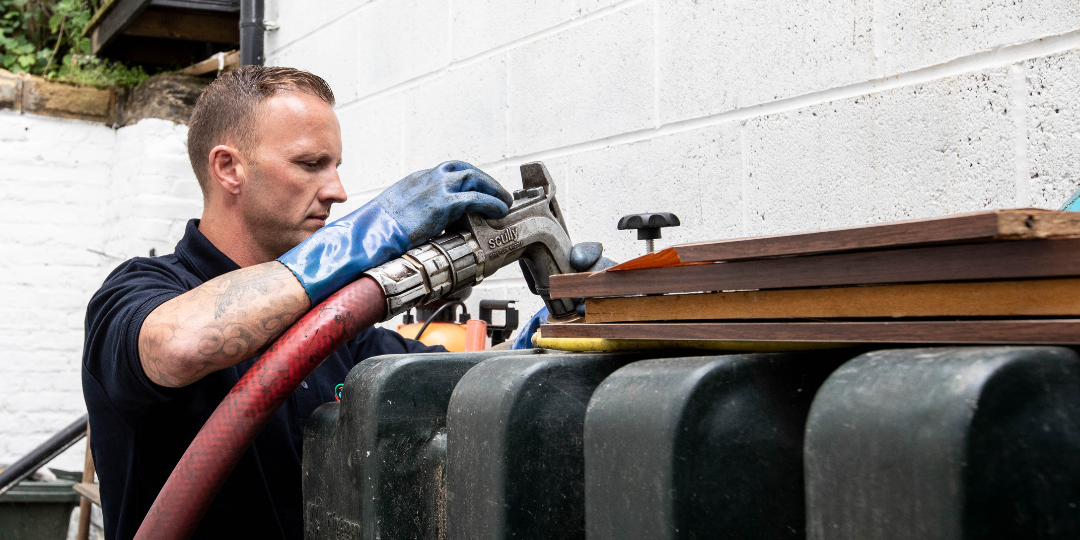
Diesel in a standby generator starts to age from the day it's delivered, and fuel containing biodiesel can deteriorate within months. Most sites don't notice until the mains fails and the generator can't keep the power running.
This guide shows commercial and industrial sites how to calculate runtime, test stored fuel and plan fuel turnover.
Jump to:
- Why stored diesel degrades
- How often to test and turn over fuel
- When to replace generator fuel
- Which fuel to use
- How long a generator runs on a full tank
- Standby generator fuel FAQs
Why does stored diesel fuel degrade in a standby generator?
Fuel stored in a standby generator degrades because it reacts with oxygen, takes on water and gives microbes somewhere to grow. Standby tanks suffer most because the fuel sits still for months and is only disturbed by short test runs.
The biggest cause of degradation is FAME (fatty acid methyl ester), the biodiesel component found in most standard diesel. According to guidance on biodiesel in standby generator sets, EN 590 diesel can contain up to 7% biodiesel without special labelling.
Biodiesel can hold up to five times more dissolved water than conventional diesel and oxidises faster, leaving sludge in tanks and deposits in injection systems. For this reason, use biodiesel-containing fuel within three months of purchase.
Standby generator fuel degradation timeline
There's no fixed expiry date for standby generator fuel, but degradation follows a predictable pattern.
The timeline below assumes a sealed, well-maintained tank. Heat, water and condensation in a part-filled tank all speed this up.
| Fuel age | What's happening | What to do |
|---|---|---|
| 0–3 months | Fuel is fresh. FAME-containing diesel is still within the recommended use window. | Log the delivery date, fuel type and delivery ticket. |
| 3–6 months | Oxidation begins, and FAME-containing fuel takes on water from condensation. | Turn over FAME-containing fuel, or test it monthly if you can't. |
| 6–12 months | Conventional diesel reaches the end of its typical 6–12 month storage window. Water collects at the tank base, and microbial growth can start. | Test the fuel. Polish it if contamination is caught early. |
| 12 months+ | Sludge forms, filters block and the fuel turns acidic, which can damage pumps and injectors. | Test before you rely on it, and plan replacement. |
How often should you test and turn over standby generator fuel?
Test FAME-containing fuel monthly once it's been stored for more than three months, and test FAME-free fuel at least every six months. Turn the fuel over whenever a test fails, and review the age of your stock every three months for FAME-containing fuel and every 12 months for FAME-free fuel.
Standby generator fuel turnover schedule
| Task | How often |
|---|---|
| Log each delivery (date, fuel type, duty status, ticket) | Every delivery |
| Check for and drain water at the tank base | Monthly |
| Run the generator under load | As your maintenance contract specifies |
| Laboratory fuel test | FAME-containing fuel: monthly after 3 months in storage FAME-free fuel: at least every 6 months |
| Tank inspection by a competent person | Annually |
| Turnover review | FAME-containing fuel: every 3 months FAME-free fuel: every 12 months |
When should you replace generator fuel?
You should replace stored generator fuel when it has begun to break down. If it's contaminated but still usable, consider polishing it instead.
Fuel polishing pumps stored fuel through filters and water separators to remove free water, sediment and microbial growth, then returns it to the tank. It's usually quicker and cheaper than replacement when problems are caught early, but it can't reverse oxidation, and aged fuel stays unstable after polishing.
If you can't tell from a visual check whether your generator fuel has broken down, a laboratory fuel test will tell you more.
- Polish it if testing finds water, sediment or light microbial growth but the fuel is otherwise within specification.
- Replace it if testing finds poor oxidation stability, high acidity or heavy sludge.
- Replace unknown fuel where the age, origin or duty status cannot be confirmed.
- Arrange uplift and tank cleaning if the tank itself also needs inspection or cleaning.
What should a generator fuel test check?
A generator fuel test should check biodiesel content, water, acid number, oxidation stability and sediment. Limits vary by manufacturer.
- Biodiesel content: 5% maximum. This also tells you whether the three-month cycle applies.
- Water: 200 ppm (parts per million) maximum.
- Acid number: 0.3 mg KOH/g maximum. This measures how acidic the fuel has become.
- Oxidation stability: 6 hours minimum (EN 15751). This shows how well the fuel resists breaking down.
- Water and sediment: 0.05% by volume maximum.
What fuel should a manufacturing site use in its standby generator?
A manufacturing site must use fully duty-paid fuel in its standby generator, and FAME-free fuel is the most stable choice for long storage.
Since 1 April 2022, red diesel can only be used to generate electricity for premises that aren't used for commercial purposes.
HMRC's Excise Notice 75 treats any fixed or mobile generator supplying a site as generating electricity for that site, so a factory's backup generator can't run on rebated fuel. HMRC can seize a machine containing fuel it shouldn't hold and can ask you to prove the fuel in your tank is fully duty-paid.
The compliant options for a commercial standby generator tank are:
- FAME-free gas oil: Contains no biodiesel, which makes it more resistant to water uptake and diesel bug (microbial contamination) in long-term storage.
- HVO fuel: A renewable, biodiesel-free fuel made to the EN 15940 standard. Check your generator manufacturer approves it for your engine.
- White diesel (DERV): Fully duty-paid, but it can contain up to 7% FAME. It needs the shorter testing and turnover cycle, and it may exceed some manufacturers' biodiesel limits for standby generators, so check your engine's fuel specification.
How long will a standby generator run on a full tank?
A standby generator runs for as long as its usable fuel lasts at the load it's carrying. To work it out, divide the usable fuel in your tank by the generator's hourly consumption at that load.
To find your own generator's hourly fuel burn, check its data sheet or use the table below. For a size that isn't listed, scale from the nearest row. A 200 kVA generator, for example, uses twice as much as a 100 kVA one.
Estimated diesel consumption by kVA and load (litres per hour)
| Generator size | 25% load | 50% load | 75% load | 100% load |
|---|---|---|---|---|
| 60 kVA | 4.2 | 7.2 | 9.6 | 12.0 |
| 100 kVA | 7.0 | 12.0 | 16.0 | 20.0 |
| 250 kVA | 17.5 | 30.0 | 40.0 | 50.0 |
| 500 kVA | 35.0 | 60.0 | 80.0 | 100.0 |
| 1,000 kVA | 70.0 | 120.0 | 160.0 | 200.0 |
Treat these as planning figures. Your generator's data sheet gives exact consumption at each load step, and that's the number you should use. Also, don't plan on the tank being at full capacity. Fuel below the suction point can't be drawn, and you need a reserve so the generator never runs dry mid-outage.
Keep your standby generator ready with Your NRG
When the mains fails, your generator needs fuel you know is fresh. Your NRG delivers duty-paid FAME-free gas oil and white diesel to manufacturing sites across England and Scotland from more than 20 depots and a 148-strong tanker fleet. Every load comes with a dated delivery ticket for your turnover records and your evidence of duty paid.
Book a fuel order today, or call our commercial team on 01642 686000.
Standby generator fuel FAQs
How long does diesel last in a standby generator tank?
Conventional diesel typically stays usable for 6–12 months in a standby generator tank, while diesel containing biodiesel should ideally be used within three months. Heat, water and condensation in a part-filled tank shorten this further. A laboratory fuel test is the reliable way to confirm whether stored fuel is still fit to use.
Can I use red diesel in a standby generator?
Red diesel can only be used in a standby generator that produces electricity for non-commercial premises, following the UK rule change on 1 April 2022. Factories and other commercial sites must run their generators on fully duty-paid fuel, such as FAME-free gas oil, HVO or white diesel.
Can HVO be used in a standby generator?
HVO can be used in a standby generator if the engine manufacturer has approved it for that engine. HVO (hydrotreated vegetable oil) is a biodiesel-free fuel made to the EN 15940 standard and is among the recommended fuels for standby generators. Check the engine's fuel approval before switching from diesel.