Jump to:
- What regulations apply to storing red diesel?
- What are the rules for storing red diesel on a farm?
- Where should a red diesel tank be located?
- How long does red diesel last in storage?
- Does red diesel freeze?
- Is red diesel flammable?
- What is the specification for red diesel?
- Need help with red diesel storage or supply?
What regulations apply to storing red diesel?
The regulations that apply to storing red diesel depend on where you are in the UK, how much you store and what it's used for.
In England, most businesses with an above-ground oil container that holds 201 litres or more must follow the Control of Pollution (Oil Storage) (England) Regulations 2001, while farms storing fuel for agricultural use follow separate rules.
Both sets of rules require secondary containment – usually a bund – that can hold at least 110% of the tank's capacity, so any leak is caught before it reaches the ground or nearby water. You can read the full Control of Pollution (Oil Storage) (England) Regulations 2001 on legislation.gov.uk.
The oil storage regulations don't apply to private homes with a tank of 3,500 litres or less, but new tanks still need to meet Building Regulations. If you're storing fuel for a home heating system, see our guide to home heating oil tank regulations.
Scotland, Wales and Northern Ireland have their own oil storage regulations, with different requirements. For more detail on the rules in England, see the government's guidance on oil storage regulations for businesses.
What are the rules for storing red diesel on a farm?
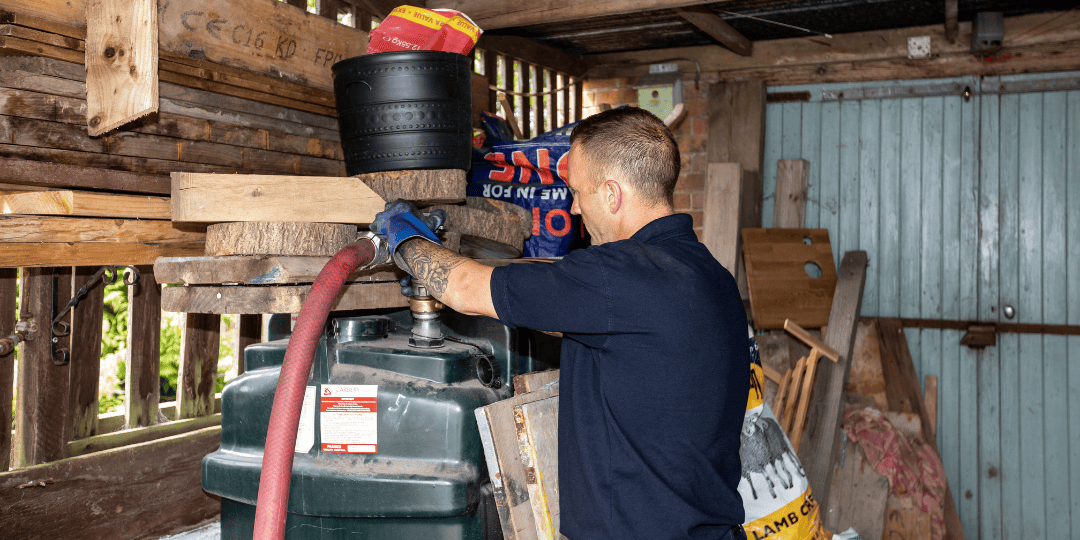
In England, farms storing more than 1,500 litres of fuel oil for agricultural use must follow the Silage, Slurry and Agricultural Fuel Oil (SSAFO) Regulations 2010.
The storage area must be surrounded by an impermeable bund holding at least 110% of the tank's capacity, and no part of it can be within 10 metres of inland or coastal waters.
You should also avoid siting a tank within 50 metres of a well, borehole or spring used for drinking water. Fuel stored to heat the farmhouse falls under different rules from fuel stored for farming, so check which rules apply to each tank on your land.
We deliver red diesel to farms across England, Scotland and Wales – find out more about our agricultural fuel supply.
Where should a red diesel tank be located?
A red diesel tank should be sited away from watercourses, drains and drinking water sources, on a stable base, and somewhere a delivery tanker can reach safely.
As a guide, keep tanks at least 10 metres from inland or coastal waters and 50 metres from a well, borehole or spring – for agricultural fuel stores, the 10-metre distance is a legal requirement.
Avoid areas at risk of flooding. The oil storage rules also require tanks to be positioned away from driveways, tanker turning circles and forklift routes, or protected with barriers or bollards, so they can't be damaged by vehicles or machinery.
Tanker access matters too – if your tank is down a narrow lane or in a tight yard, let us know when you order so we can send the right vehicle from our range of commercial fuel tankers.
How long does red diesel last in storage?
As a general guide, red diesel stored in a clean, well-maintained tank should stay in good condition for around 12 months. Standard red diesel can contain up to 7% biodiesel (FAME), which absorbs water and breaks down over time, so check stored fuel regularly for water and contamination.
If fuel needs to sit for months at a time – for a standby generator or a boat over winter – FAME-free gas oil stays in better condition. Keeping your tank in good repair and ordering smaller, more regular deliveries rather than storing fuel for long periods also helps.
Does red diesel freeze?
Red diesel doesn't freeze like water, but it can thicken in very cold weather. As the temperature drops, natural waxes in the fuel start to form crystals, making it look cloudy. If it gets cold enough, these crystals can block filters and fuel lines, a process known as gelling.
Gas oil supplied in winter is usually treated to cope with lower temperatures than summer-grade fuel. Exposed tanks and fuel lines are most at risk, so insulating pipework and keeping tanks sheltered can help.
Is red diesel flammable?
Red diesel is flammable, but it has a much higher flash point than petrol, so it doesn't ignite easily at normal temperatures. It still needs to be stored safely, away from heat, naked flames and other ignition sources, in a tank designed for oil storage.
What is the specification for red diesel?
Red diesel supplied for off-road machinery in the UK is low-sulphur gas oil made to the British Standard BS 2869. It's dyed red and chemically marked so HMRC can identify it, and standard red diesel can contain up to 7% biodiesel (FAME).
Road diesel is made to a different standard, EN 590, but the two fuels are very similar. Red diesel doesn't burn faster or perform worse than road diesel – the main differences are the marker, the duty rate and who can use it. See how white diesel compares to other diesel fuels.
Need help with red diesel storage or supply?
If you have questions about storing red diesel or need a delivery, our fuel team can help. Check who can still use red diesel, find out how much red diesel costs or get a red diesel quote online.
For anything else, talk to our fuel team.