Jump to:
- How should you plan fuel supply for a new construction site?
- Where and how should you store fuel on site?
- What access does a fuel tanker need?
- How quickly can fuel reach a construction site in an emergency?
How should you plan fuel supply for a new construction site?
Planning a new site's fuel supply starts about four weeks before work actually begins. This should give you time to size the fuel storage, position a tanker, open a commercial account, and confirm access before equipment arrives on site.
Here's an easy timeline to keep in mind when planning a fuel supply for a new site:
- Four weeks out: Estimate consumption from your plant schedule and working hours. Choose storage: bulk tank, bowser, or an IBC (a 1,000-litre intermediate bulk container) for short programmes. Confirm your commercial fuel supplier at this time, too.
- Three weeks out: Position storage on the layout drawing. Check the tanker route against your traffic management plan.
- Two weeks out: Send tanker access photographs. Set a reorder trigger at a quarter of capacity, or arrange scheduled top-ups. Choose your fuel contact and a deputy.
- One week out: Confirm the first delivery date and window. Brief the gate team on access and induction. Check the fill point is clear.
- Week one onward: Dip the tank weekly and check against working hours. Review at month one and adjust.
Need fuel on site urgently? Your NRG provides emergency fuel delivery for construction sites across the UK. Get your free quote now.
Five photographs worth taking before your fuel delivery
Send these with your first order to confirm the best size tanker.
- Site entrance from the public highway – Gate width and height restrictions
- Approach route, gate to delivery point – Turning room and pinch points
- The standing position – Ground surface and levels
- Tank or fill point – Coupling type and bund
- Any obstruction – Overhead cables, low scaffold, tight radius, parked plant
Where and how should you store fuel on site?
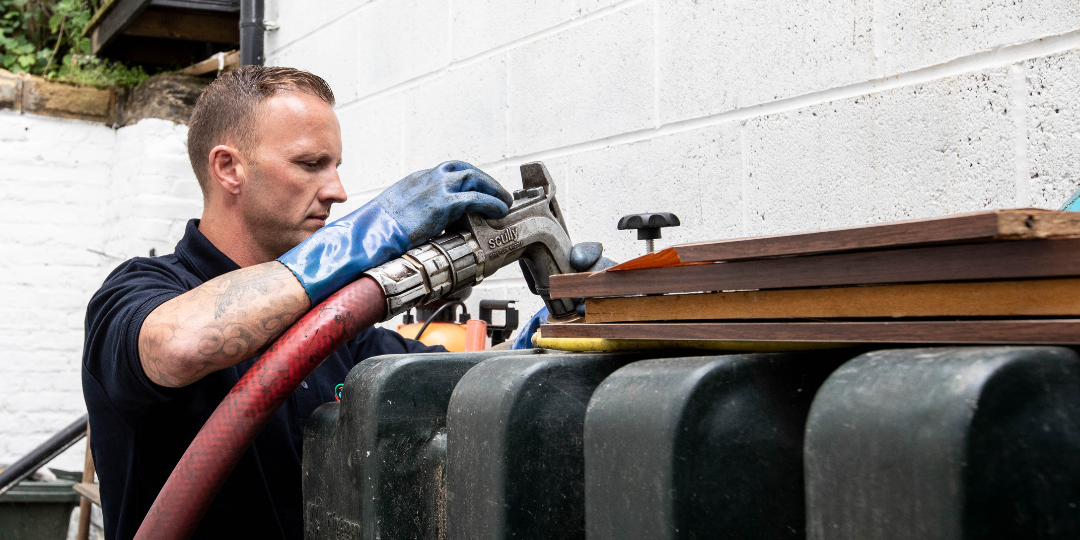
Bulk fuel should be stored in a secure, accessible location away from drains, watercourses, ignition sources and areas where vehicles or plant could strike the tank. The site operator is responsible for making sure storage meets the relevant requirements and remains accessible for tanker deliveries.
- Any above-ground container of 201 litres or more needs a second container around it to contain leaks and spills.
- The bund must hold at least 110% of the tank's capacity.
- Ignition and hazardous area controls fall under DSEAR (Dangerous Substances and Explosive Atmospheres Regulations).
For more details, read more here:
What access does a fuel tanker need?
A fuel tanker typically needs between 2.1m and 3.7m of clearance, depending on its size. We run a variety of tanker sizes for this reason, including:
| Tanker | Capacity | Clearance | Other requirements |
|---|---|---|---|
| Articulated | 36,000 litres | 3.7m (12ft) | Wide roads, generous turning room |
| Six-wheeler | 18,000 litres | 3m (10ft) | Must park within 60m of the delivery point |
| Four-wheeler (18t) | 11,500 litres | 2.5m (8ft) | Suits narrow lanes and tight yards |
| Four-wheeler (12t) | 8,000 litres | 2.1m (7ft) | Built for restricted access |
Rule of thumb for the six-wheeler: if a bin lorry can get in, so can the tanker.
How quickly can fuel reach a construction site in an emergency?
Fuel can usually reach a construction site within hours if the supplier dispatches from a depot near you rather than a central hub.
Two things slow an emergency order down. The first is access: if the driver doesn't know how to get into your site, a delivery that should take hours can cost you a day.
The second is the order cut-off, so when you set up your construction fuel supply, double-check cut-off times and any possible out-of-hours delivery needs. It's much easier to find this out before you need it.
Have the details ready when you ring. Your driver will need the site address and postcode, plus what3words or a gate number where the postcode doesn't make the entrance clear, along with a site contact name and mobile.
Your supplier will also need the fuel type and volume, the delivery point (static tank, bowser or direct to plant) and any induction, permit or escort requirements.
Keep your construction site fuelled with Your NRG
Keep things moving with reliable bulk fuel deliveries from Your NRG – directly from our UK depot network. With competitive rates and a 4.8 Feefo rating from more than 15,000 verified reviews, you can count on a commercial fuel supply built around your needs.
Set up your construction fuel supply with Your NRG today or request a bulk fuel quote online.